
Curriculum / Oracy
Our intent is for all our pupils to be confident speakers, agile communicators, and effective listeners. We believe that developing oracy throughout primary education provides our students with vital life skills. We aim to encourage fluent speakers, who are confident to communicate, debate and present in a wide range of situations.
We want all pupils to be able to use their voice confidently across a range of different contexts, to adapt their use of language for a range of different purposes and audiences, to recognise the importance of listening in conjunction with speaking and listening and to apply all the learnt oracy skills to all areas of the curriculum and in their wider lives.

According to the Curriculum and Assessment Review (2025), oracy is the ability to speak and listen effetcively for learning, communication and participation. it must be taught deliberately and progressively—helping pupils think aloud, reason together, and express ideas with clarity and confidence across every subject.
Tongue Fu Talking® provides a complete Structured Oracy System that turns this expectation into a classroom reality. It provides teachers with explicit practices, mapped progression, and fully supported resources, so systematic oracy teaching becomes both practical and achievable in every subject.
We use our Oracy Framework to carefully plan oracy opportunities into English and wider curriculum lessons. Questions are differentiated to ensure full participation and pupil discussions are scaffolded by using KS1 and KS2 differentiated focused sentence stems to ensure progression.
We also use the Voice 21 oracy framework and Tongue fu, which breaks down the teaching of speaking and listening into four strands:
Physical
Cognitive
Linguistic
Social and Emotional
These four strands enable successful discussion, inspiring speech and effective communication.
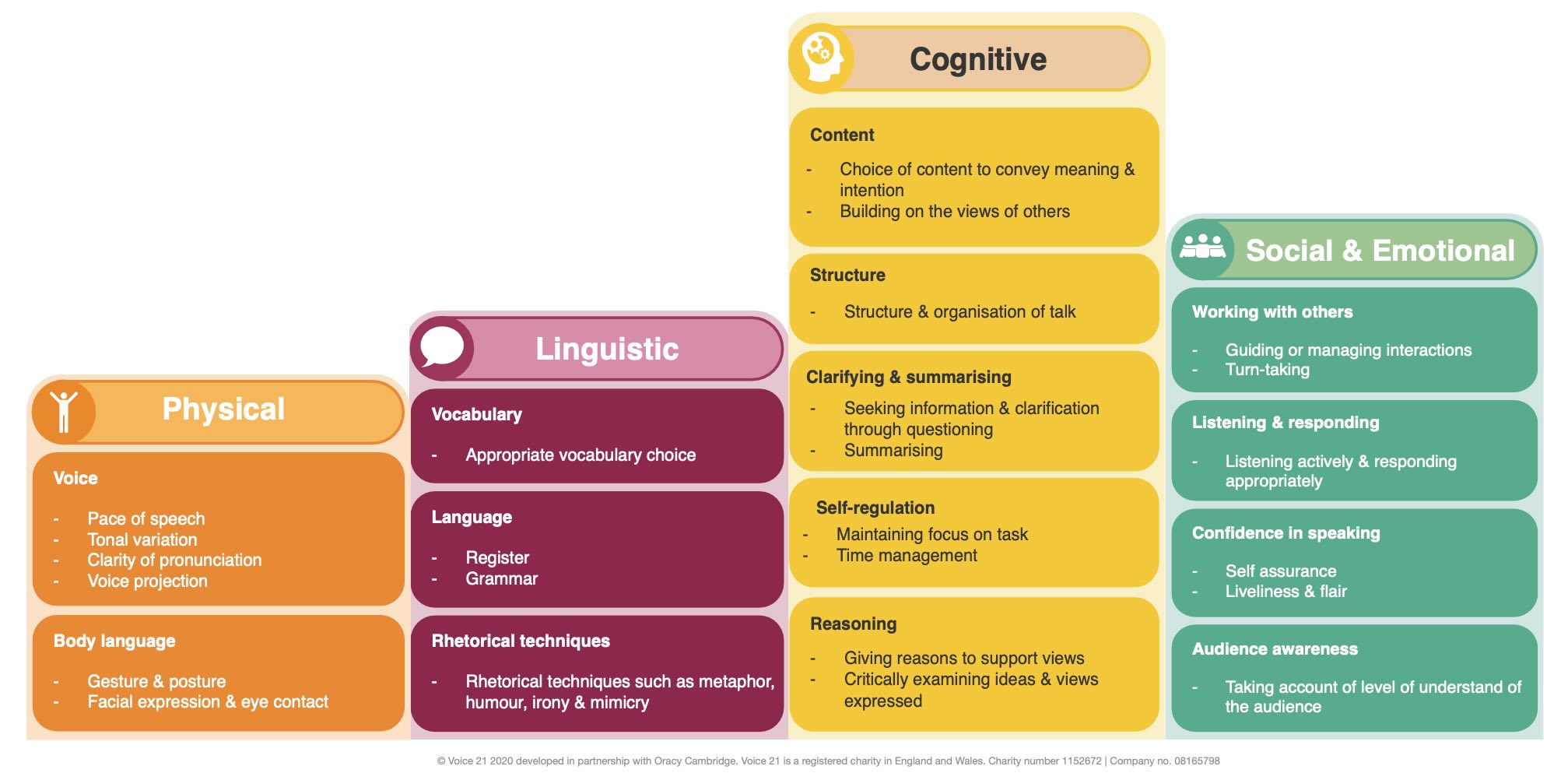
Teachers use the Oracy Framework to praise and highlight the achievements of the students. Pupils use the framework in class and during the oracy phase assemblies to self-assess, peer-assess, and talk about talk.
We have adapted Tongue Fu Talking framework to tackle these 4 strands
Modes of Talk
- Explorer Mode: Supports collaborative thinking, reasoning and problem-solving
- Presenter Mode: Focuses on clarity, confidence and purposeful delivery
The Four Disciplines
- The Stance (Physical presence and delivery)
- The Flow (structure and language)
- The Mind (thinking, reasoning and metacognition)
- The Bond (listening, empathy and social connection)
Each discipline contains specific practices that are taught explicitly and rehearsed regularly.
Progression: The Belt System
- White Belt: Foundation (EYFS to KS1)
- Green Belt: Developing (KS1 to Lower KS2)
- Brown Belt: Competent (Lower KS2 to. Upper KS2)
- Black Belt: Mastery (Upper KS2 to KS3)
Progression is flexible and inclusive. Pupils are supported to develop confidence and competence in their own way.
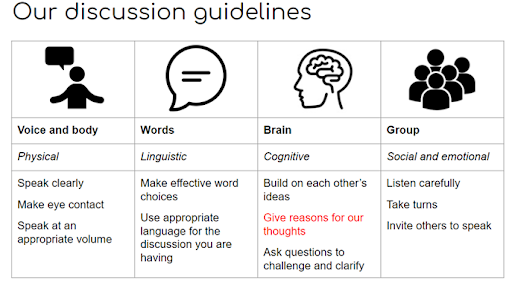
Discussion Guidelines
We use a set of guidelines for partner and group discussion that help to maintain a safe, effective and respectful environment for talk.
Talk time Tools
Talking Tools allow our pupils to self-govern talk. These also help to develop speaking and listening skills.

Discussion Sentence stems
The sentence stems support pupils of all ages and abilities to access partner or group discussion. For ‘Debate and Persuasion’ talk purpose some of the sentence stems we use are:
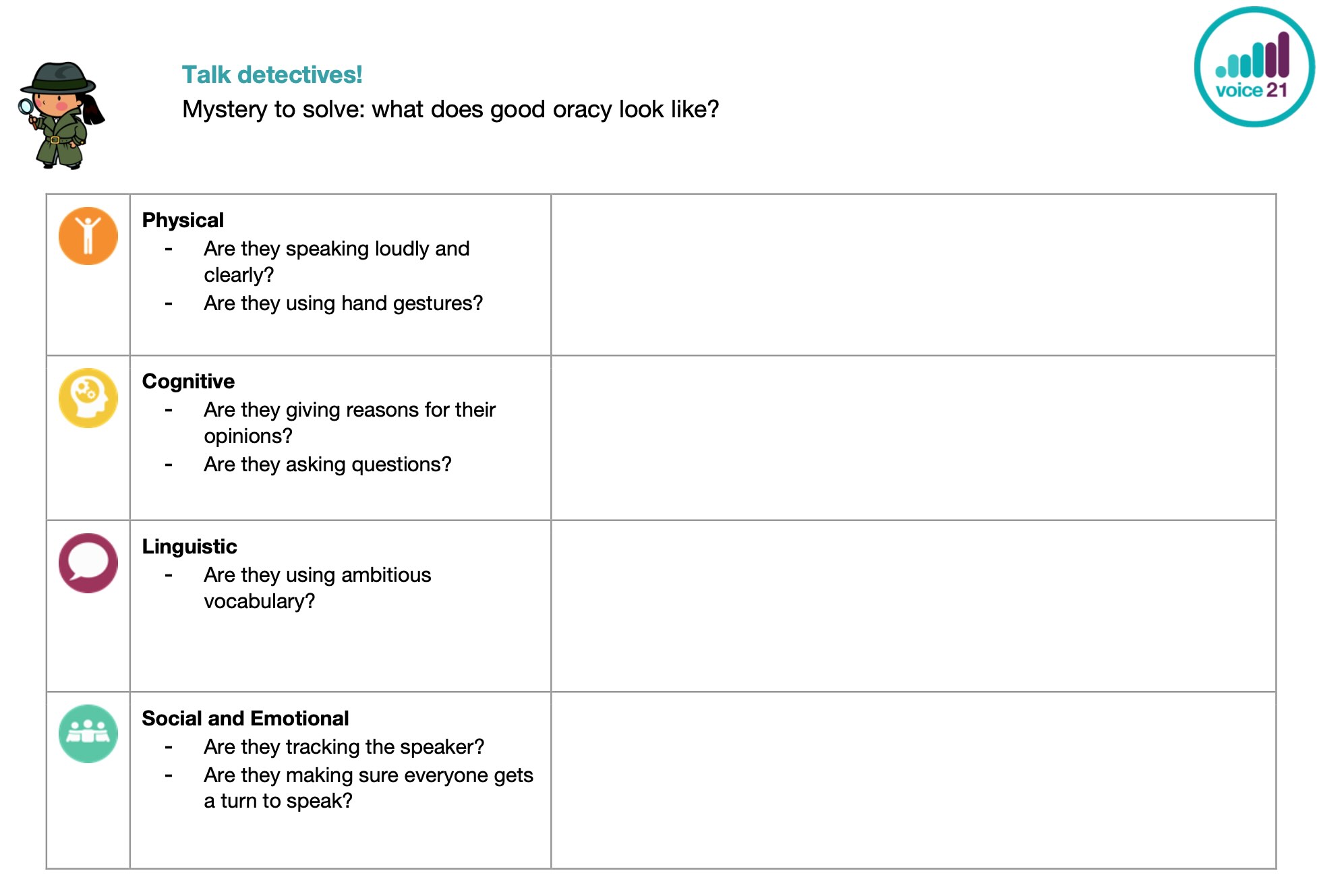
Talk Detective
Talk Detectives allow pupils to step out of a discussion and recognise which oracy skills are being used and if discussion guidelines are being followed.
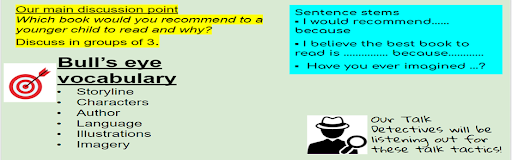
Bull's eye vocabulary
This activity encourages our children to develop, build and use challenging vocabulary when explaining their learning.
Groupings
This activity encourages our children to develop, build and use challenging vocabulary when explaining their learning.
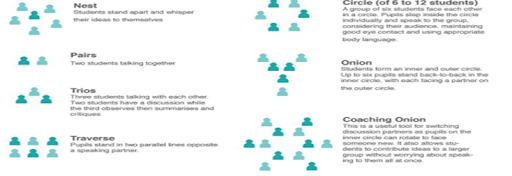
As a school we are committed to raising and maintaining high standards in English. Oracy is incorporated into English lessons by planning a range of purposeful opportunities to encourage learning through talk and learning to talk, including the following ways:
Setting ground rules for speaking and listening in class, such as speaking audibly/clearly, putting the hand up before speaking, waiting to be chosen, taking turns to speak, speaking at an appropriate volume, not interrupting each other, and showing respect while critically engaging with each other’s ideas
Discussions in pairs, small groups or whole class, for example about making predictions, characters, story plots, or expressing personal opinions
Group work where communication and listening to each other are essential.
Using full sentences to answer questions as well as when sharing thinking with the talk partners
Using sentence stems for a particular talk tactic eg to summarise use the sentence stem-The main idea was …….
Drama and role play- where children pretend to be someone else or pretend to be in a specific situation that they are not actually in at the time. It is a directed activity where children are given questions to think about and sentence stems to use during the role play which then leads to the writing outcome
Exploring a text through performance – not just re-enacting what happens in the book, but also acting out what characters might do or say in a particular situation
Presentations which could be individual presentations or in pairs or in small groups for example presenting their own stories, performing poems, creating and presenting their own characters.
Using key vocabulary while communicating with others
Asking questions for example using picture stimulus to ask questions and then make predictions
Answering questions providing justifications by using evidence from the text or the knowledge about the text
Oracy is incorporated in maths lessons to increase Mathematical vocabulary, support children in proving or justifying their answers and to address misconceptions. Oracy has a particularly important role in Mathematical reasoning questions, which have a focus on children communicating their understanding of Mathematics accurately. Children work collaboratively to solve a problem and justify their answers. Sentence stems are used to support discussion.
We have our broad and balanced curriculum to develop understanding and higher-order thinking. Oracy supports pupils to make their thinking clear to themselves as well as others. Oracy skills that were originally mastered in discreet oracy lessons are now incorporated across the curriculum using Earlham’s Oracy Framework.
At The Leys, we have carefully mapped the progression of oracy skills across the school:
The impact oracy has on our children is clear to see. Our children are confident speakers, and they embrace opportunities to speak whether it be in the classroom, in assembly, in front of visitors or in front of parents. The proof of oracy learning that has taken place is heard in the voices of the children that we teach. It will be heard when listening to them recite a poem, watching them take turns in a group discussion, felt through the profound questions they ask and the attentiveness with which they listen.
We have found that when children explore learning through various oracy strategies and are exposed to new vocabulary, they better retain this knowledge. This leads to learning becoming memorable and engrained. Meaning when children are presenting or writing, the language they use are of a higher level with a deeper understanding.
Next year our target is to build in self/peer assessment opportunities after the oracy input using the four strands of oracy framework – Physical, Cognitive, Linguistic, Social and Emotional. This will enable each child in school to highlight their strengths and focus on areas for development. Hence, providing teachers an opportunity to adapt the planning, teaching and evaluation cycle to assist children to achieve their targets.
We have our broad and balanced curriculum to develop understanding and higher-order thinking. Oracy supports pupils to make their thinking clear to themselves as well as others. Oracy skills that were originally mastered in discreet oracy lessons are now incorporated across the curriculum using Earlham’s Oracy Framework.
At The Leys, we have carefully mapped the progression of oracy skills across the school: